
Wood vs. Plastic Solar Panel Pallets: Total Cost of Ownership Breakdown
The U.S. solar industry spent over $1.5 billion on single-use solar panel packaging costs in 2024. That includes $636 million in packaging purchases, $127 million in disposal fees, and hundreds of millions more in module damage and labor tied up managing packaging waste across utility-scale job sites.
Most of those costs are accepted as a normal part of doing business. They shouldn’t be.
The shift from wood to reusable plastic solar panel pallets doesn’t just benefit one part of the supply chain—it changes the economics for everyone in it. Manufacturers reduce packaging spend and run cleaner facilities. EPCs and owner/developers eliminate disposal fees, protect panels through outdoor staging, and run safer, more efficient sites. The savings stack differently depending on where you sit, but everyone wins.
Here’s how the total cost of ownership compares across the solar supply chain.
How Solar Panel Packaging Costs Flow Through the Supply Chain
Before diving into who saves what, it helps to understand how solar panel packaging costs flow through the supply chain—and who’s currently absorbing them.
Manufacturers purchase wood pallets and cardboard to ship panels from their facilities to distributors, installers, and project sites. That packaging spend is a direct cost of goods, and the condition panels arrive in, as well as storage requirements, reflects directly on them.
Distributors receive panels on those pallets, re-stage them in warehouses, and ship them to installers. They absorb handling costs and damage risk at multiple touchpoints.
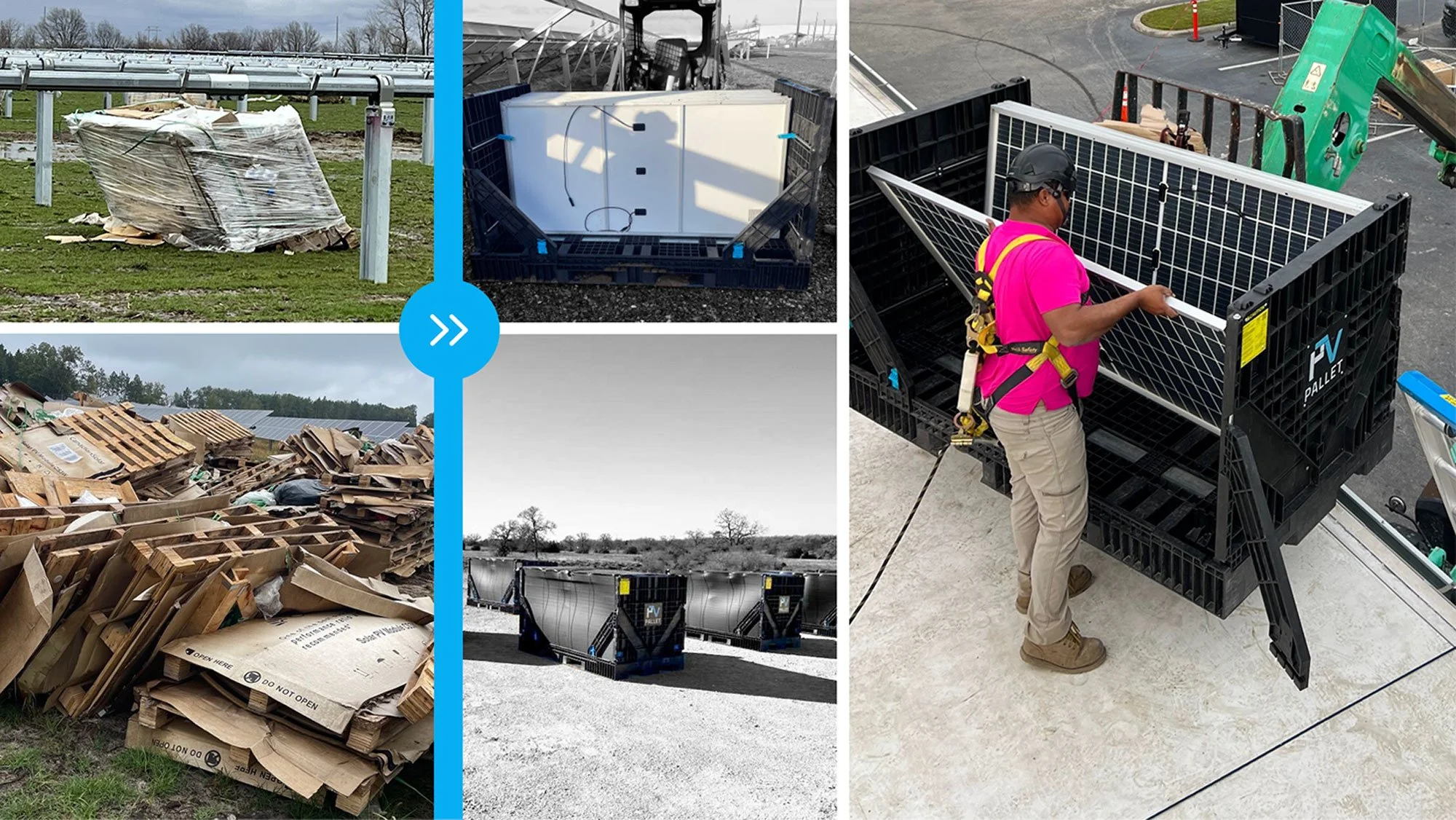
EPCs, Owners, and Developers receive panels on utility-scale job sites and are left holding the disposal problem. They pay to haul away wood, cardboard, and plastic wrap (and the labor involved to pick up all the packaging). They also absorb the cost of project delays when panels don’t arrive in installable condition.
In a single-use system, costs accumulate at every handoff. In a reusable system with proper return logistics, all parties see cost savings.
What Manufacturers Gain
For panel manufacturers, reusable solar panel pallets deliver savings on the input side and competitive advantage on the output side.
Lower Packaging CAPEX
Wood solar panel pallets typically run $50–$100 each and are discarded after a single use. They’re a pure consumable—purchased for every shipment, recovered from none. Reusable plastic solar panel pallets run $300–$500 upfront, but in a closed-loop return system they become assets that pay for themselves within a handful of trips and continue delivering value long after.
For manufacturers shipping at volume, the cumulative spend on single-use wood adds up to millions of dollars annually. Reusable systems recapture a meaningful portion of that spend and convert a recurring cost into a managed asset.
Cleaner, More Efficient Facilities
Wood pallets shed. Splinters, debris, and sawdust accumulate on warehouse and production floors, creating housekeeping overhead and, in some environments, contamination concerns. Managing and disposing of degraded wood pallets adds labor that has nothing to do with manufacturing panels.
Reusable plastic pallets are dimensionally consistent, structurally stable, and don’t shed material. Facilities stay cleaner, handling is more predictable, and the operational overhead of managing pallet condition and disposal is largely eliminated.
Reduced Exposure to Damage Claims
Transit damage is a reality in any supply chain. While the causes are varied and not always attributable to packaging alone, reusable pallets—engineered specifically for solar panel geometry and load requirements—reduce the conditions that lead to damage during transport. Consistent dimensions eliminate load shift. Smooth surfaces eliminate contact points that scratch glass. Structural integrity doesn’t degrade over multiple handling cycles the way wood does.
Fewer damage events means fewer claims, fewer replacement shipments, and fewer difficult conversations with customers.
Customer Loyalty and Preferred Vendor Status
Manufacturers who ship on reusable solar panel pallets are increasingly differentiated in a competitive market. EPCs and developers managing utility-scale projects notice when a supplier’s panels arrive clean, stable, and without a disposal problem attached. That experience shapes vendor preference over time.
Reusable packaging also removes the friction points—site complaints, disposal overhead, damage disputes—that quietly erode customer relationships. Manufacturers who solve those downstream problems for their customers don’t just retain business. They become the default choice.
What EPCs, Owners, and Developers Gain
For the companies receiving and installing panels at utility scale, switching from wood to reusable solar panel pallets saves money and reduces overhead in four distinct areas.
Solar Pallet Disposal Costs
This is the most consistent and least-tracked cost in utility-scale solar project budgets. Wood pallets are single-use by nature—after panels are unloaded, the pallets are burned or hauled away. On a typical 100 MW project, EPCs spend $250,000 or more on dumpsters and hauling to remove wood pallet and packaging waste. Across the U.S. industry in 2024, solar pallet disposal fees totaled $127 million—more than 85,000 dumpsters of wood waste sent to landfills.
That cost recurs on every project. It’s not a one-time expense; it’s a structural inefficiency that compounds across an entire project portfolio.
Reusable solar panel pallets eliminate it. When panels ship on returnable packaging, nothing gets left behind on site. The pallets go back into circulation, disposal fees drop to zero, and project budgets stop absorbing a cost that was never necessary.
Outdoor Storage and Weather Protection
At utility scale, solar panels routinely sit staged outdoors for days or weeks before installation. Wood pallets absorb moisture, warp under weather exposure, and degrade structurally over time—compromising the stability of the panels stacked on them. Wet, degraded wood also creates contact conditions that can damage panel frames and surfaces.
Reusable plastic solar panel pallets are non-porous and weatherproof. They don’t absorb moisture, don’t warp, and maintain structural integrity through extended outdoor staging. Panels that arrive on plastic pallets stay protected and stable whether they’re installed the next day or three weeks later.
Module Condition on Delivery
The structural consistency of reusable solar panel pallets—uniform dimensions, stable load surfaces, no protruding fasteners—reduces the conditions that lead to panel damage during transport and handling. While many factors affect module condition across a long supply chain, packaging is one the industry can control directly.
Fewer damaged panels means fewer replacement orders, fewer installation delays, and less administrative overhead managing damage claims and inventory discrepancies on active project sites.
Job Site Safety
Wood pallet debris is a normalized hazard on solar job sites: broken boards, loose nails, splintered edges. At utility scale, where crews are moving quickly across large laydown areas and staging zones, that debris creates real injury risk.
Reusable plastic solar panel pallets eliminate the debris. Staging areas stay clear, handling conditions are consistent, and crews can move through laydown yards without the hazards that come with degraded single-use packaging.
Solar Pallet Cost Comparison: Wood vs. Reusable Plastic
Wood solar panel pallets are a one-job consumable—purchased, used once, and discarded or burned. Reusable plastic solar panel pallets are rated for long-term, repeated use. That changes the per-use cost comparison significantly:
Wood
Purchase price: $100
Lifespan: 1 trip
Cost per trip: $100
Reusable Plastic
Purchase price: $300-500
Lifespan: Long-term, repeated use
Cost per trip: drops with every trip
Most reusable systems reach break-even within 2 to 5 uses. After that, every additional trip widens the savings gap—and unlike wood, the packaging cost doesn’t reset to zero with each new shipment.
Which Solar Panel Pallet Is Right for Your Operation?
When Wood Pallets Still Make Sense
Wood pallets remain the right choice in specific scenarios:
One-time or export shipments where return logistics aren’t feasible
Panels shipping from overseas manufacturers, where a closed-loop return program isn't practical
Shipment volumes too low to support a closed-loop program
When Reusable Plastic Pallets Are the Better Investment
Reusable solar panel pallets deliver the strongest return in a domestic, closed-loop supply chain—where pallets can be consistently recovered, returned, and put back into circulation. They consistently deliver better total cost of ownership when:
Manufacturers are shipping domestically at volume and want to reduce packaging costs
EPCs are running utility-scale projects with recurring disposal fees
Panels need to be staged outdoors for extended periods before installation
Site safety and operational efficiency are priorities
The Bottom Line on Solar Panel Pallet Costs
Single-use wood pallets look cheap on a PO. The $1.5 billion the U.S. solar industry spent on packaging-related costs in 2024 tells a different story.
The shift to reusable solar panel packaging isn’t a sustainability initiative with a cost attached—it’s a business decision with returns distributed across the supply chain. Manufacturers reduce packaging spend, run cleaner facilities, and strengthen customer relationships. EPCs and developers eliminate disposal costs, protect panels through outdoor staging, and run safer sites. The economics work for everyone in the chain.
Talk to a Solar Packaging Specialist
Whether you’re a manufacturer evaluating packaging costs or an Owner/Developer looking to reduce disposal and operational overhead on utility-scale projects, the right solution depends on your volume, logistics structure, and supply chain setup. Contact us and our team can help you model the economics for your specific situation.